Angle Seat Valves vs. Other Valve Types: A Detailed Comparison for Engineers and Facility Manager

George Packard
Read Full Bio
Selecting the right valve is one of the most important decisions in any fluid control system. The choice affects efficiency, operating costs, service life and how well the system can adapt to changes in demand. A valve that isn’t suited to the application can lead to pressure loss, poor sealing or premature wear, all of which can cause unplanned downtime.
Among the many valve designs available, angle seat valves are known for handling demanding applications involving steam, hot water and fluids that are corrosive, abrasive or otherwise harsh on valve materials. Their fast operation and durability make them a common choice in certain high-cycle or high-temperature processes.
However, they are far from a one-size-fits-all solution. In many cases, a ball valve or another valve type may be more practical or cost-effective over the long term.
This guide explains what angle seat valves do well, where they fall short and how they compare to other common valve types, particularly ball valves, which are often the go-to option for general shut-off and control.
What Is an Angle Seat Valve?
An angle seat valve is a pneumatically actuated valve with the seat positioned at an angle to the flow path. This setup enables the disc or plug to move out of the flow path more efficiently than a standard globe valve, resulting in higher flow capacity relative to body size.
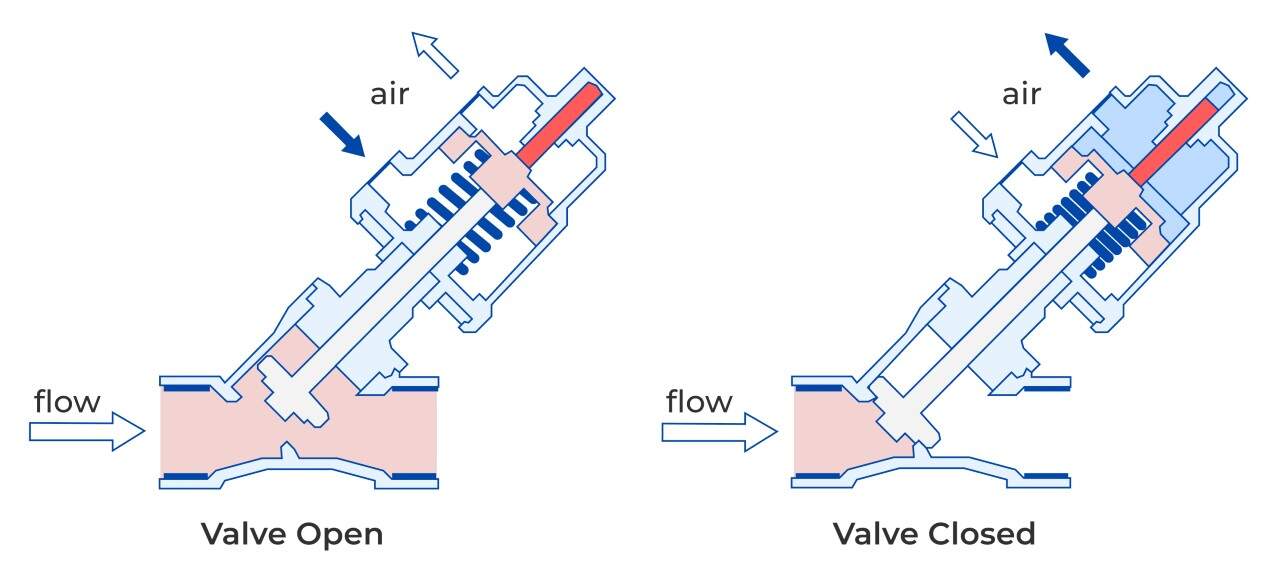
Because they are typically pneumatically operated (using compressed air), angle seat valves can cycle open and closed in fractions of a second, making them ideal for automated processes that require frequent actuation.
Key benefits of using angle seat valves include:
- High flow capacity relative to size, making them compact without compromising throughput
- Long service life in clean, high-cycle applications
- Excellent performance in high-temperature and high-pressure environments
- Material compatibility for steam, hot water and corrosive chemicals
Here are some of the common angle seat valve applications that take advantage of those benefits:
- Sterilization equipment
- Clean-in-place (CIP) systems
- Steam distribution
- Industrial washing
- Water treatment
- Process systems where rapid cycling and high temperature resistance are priorities
Potential downsides of angle seat valves:
While these valves excel in certain settings, engineers should consider their limitations:
- Higher pressure drop – The angled flow path introduces more resistance compared to the straight-through design of a ball valve. In systems where maintaining maximum flow is critical, a full-port ball valve will generally outperform an angle seat valve.
- Poorer handling of particulates – The linear closing motion can trap solids against the seat. Over time, this can prevent a tight seal or cause seat damage. Ball valves, on the other hand, tend to “wipe” particulates away from the sealing surface as they close.
- Higher potential for leakage – If the valve is installed incorrectly or subjected to excessive mechanical stress, concentrated forces at the seat can increase the risk of cracking or leakage.
These limitations don’t make angle seat valves a poor choice, but they do mean that engineers need to match them carefully to the right applications.
Overview of Other Common Valve Types
To understand when an angle seat valve is appropriate, it helps to compare it to the main valve types used in industrial and facility systems:
- Ball valves – Simple quarter-turn operation, minimal pressure drop and excellent shut-off. Suitable for a wide range of fluids, including those with particulates. Often the best all-around choice for general service. With the inclusion of a V-port ball, ball valves can also be suitable for control applications.
- Butterfly valves – Lightweight, compact and cost-effective for large-diameter, low-pressure service. Cost-effective for large-diameter lines; low profile makes them good for space-limited piping. Not as effective in high-pressure or high-temperature applications.
- Gate valves – Provide unobstructed flow when fully open and are reliable for isolation service. Slow to operate, making them less practical for frequent cycling.
- Globe valves – Well-suited for precise throttling control but create higher pressure drop compared to other valve types; better for modulating than isolation.
- Solenoid valves – Electrically actuated and ideal for small-bore, automated systems; best in clean, low-viscosity media. Not typically used for high-flow, high-temperature service.
Angle Seat Valve vs Ball Valve
Because ball valves are one of the most widely used shut-off valves in industrial systems, they are often the primary alternative to angle seat valves when engineers are deciding on a flow control solution.
Although they can serve similar roles, especially in automated systems, their strengths differ:
| Feature | Angle Seat Valve | Ball Valve |
| Flow capacity (Cv) | High for size, but more pressure drop than full-port ball valves | Very high, minimal pressure drop |
| Temperature range | Excellent for high-temperature steam and aggressive fluids | Strong, but material- and seal-dependent |
| Actuation | Typically pneumatic; very fast cycling | Manual, pneumatic or electric |
| Durability | Long cycle life in clean media | Durable, well suited to media with particulates |
| Maintenance | Requires seat inspection and replacement over time | Generally low-maintenance |
| Best for | High-temperature, high-cycle, clean media applications | General-purpose shut-off, media with particulates |
Why choose an angle seat valve?
- Need rapid pneumatic operation in a high-cycle process
- System handles clean, high-temperature media such as steam
- Compact valve size with relatively high Cv is preferred
Why choose a ball valve?
- Minimal allowable pressure drop
- System handles fluids with particulates or suspended solids
- You need flexible actuation options or a cost-effective general shut-off solution
- Long-term maintenance costs need to be minimal
Angle Seat Valves vs. Other Valves: When and Why to Choose
Choosing between valve types involves balancing performance, installation and maintenance priorities. Use the following checklist when considering an angle seat valve:
- Media type – Is the fluid clean and free of particulates?
- Temperature – Does the application involve steam or other high-temperature fluids?
- Actuation speed – Does the process require rapid cycling multiple times per minute or hour?
- Space constraints – Will the angled body fit without creating piping layout issues?
- Pressure drop tolerance – Can the system accommodate higher pressure loss compared to a straight-through ball valve?
If most of these answers are “yes,” an angle seat valve is likely a good match. If not, another valve type, such as a ball valve, may provide better overall value.
Long-Term Considerations in Valve Selection
Engineers and facility managers often focus on immediate specifications, but long-term performance factors are equally important:
- Service environment – Corrosive atmospheres or high humidity can affect actuator life and body materials. For example, in food processing plants, high humidity and cleaning chemicals can shorten actuator life if materials aren’t selected properly.
- Maintenance access – If the valve will be installed in a hard-to-reach location, consider one with a longer maintenance interval. For instance, in skid-mounted systems, compact valves with longer maintenance intervals may be necessary to avoid costly disassembly.
- Automation integration – Pneumatic angle seat valves can be integrated into automated control loops, but ball valves offer broader actuator compatibility, including electric options.
- Total cost of ownership – While some angle seat valves may have a lower initial price, ball valves can offer longer service life with fewer replacement parts in certain media conditions.
Making the Right Choice for Your System
No single valve design is ideal for every situation. Angle seat valves deliver speed, durability and temperature resistance for specific high-cycle applications. Ball valves, on the other hand, often provide broader versatility, lower pressure loss and better tolerance for particulates.
By understanding how these designs compare and how they stack up against other valve types, you can make a more informed selection that supports efficiency, reliability and system longevity. Whether you’re designing a new system or replacing worn equipment, the right valve choice ensures consistent performance, reduced downtime and easier maintenance for years to come.
Need help selecting the right valve for your system? Explore our Valve Sizing 101 Guide or contact a Gemini Valve expert for personalized support.
Angle Seat Valve FAQs
What are the key differences between angle seat valves and ball valves?
Angle seat valves are designed for fast pneumatic operation and high cycle life, especially with clean, high-temperature fluids. Ball valves offer minimal pressure drop, versatility across media types and tight shut-off performance.
In which applications are angle seat valves commonly used?
Angle seat valves are frequently used in steam systems, CIP systems, water treatment, sterilization equipment and high-cycle pneumatic processes.
Can angle seat valves and ball valves be used interchangeably?
In some cases, yes — but the decision depends on the fluid’s characteristics, system pressure, temperature and flow requirements.
What are the advantages of using an angle seat valve?
Angle seat valve advantages include fast actuation, long cycle life and reliable operation in high-temperature, clean media applications.
What are the disadvantages of using an angle seat valve?
Drawbacks of angle seat valves include higher pressure drop than a full-port ball valve, less tolerance for particulates and potential leak points if improperly installed or maintained.
When should I use a ball valve instead of an angle seat valve?
Use a ball valve instead of an angle seat valve when you need lower pressure loss, greater particulate tolerance, flexible actuation options or a more versatile shut-off solution.
George Packard
15 Factors to Consider Before Your Next Industrial Ball Valve Order
This guide includes everything you need to know before placing your next industrial ball valve order.